Fire, Smoke, & Egress Modeling
Model the Outcome Before It Happens
Advanced fire, smoke, and egress modeling that quantifies performance, validates design decisions, and supports defensible regulatory approval.
Performance-Based Modeling for Complex Environments
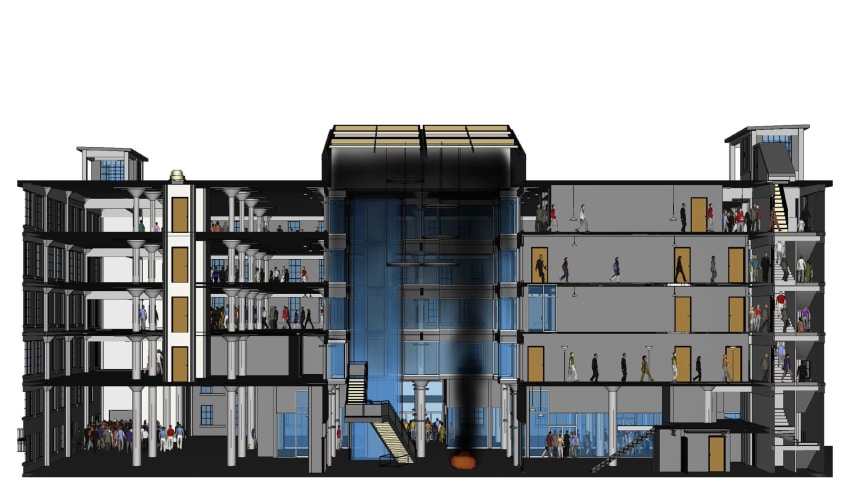
Ambitious architecture and evolving building uses often introduce safety questions that cannot be resolved through conventional review alone. Large atriums, interconnected floors, dense assembly spaces, and adaptive reuse projects demand deeper evaluation.
Summit Fire Consulting leverages fire, smoke, and egress modeling to understand how environments perform under real emergency scenarios. These simulations provide clarity, reduce uncertainty, and support informed decisions that protect both occupants and design intent.

Three Distinct Modeling Disciplines
Fire and smoke modeling work together to predict how a fire develops and when conditions in the building become untenable. Egress modeling then simulates how quickly occupants can move to a place of safety under those conditions.
Used together, these tools support performance-based design by demonstrating that available safe egress time (ASET) exceeds required safe egress time (RSET), giving project teams a defensible technical basis for performance-based design approaches.
Full-Spectrum Modeling Services
From targeted simulations to fully integrated performance-based evaluations, our modeling capabilities include:
Fire Modeling (FDS)
Smoke Modeling & Tenability Analysis
Egress Modeling (Pathfinder)
RSET/ASET Analysis
Integrated Fire & Evacuation Modeling
Human Behavior & Occupant Variability Modeling
Performance-Based Design Support
Visualization & Regulatory Documentation
Proven Track Record
Through comprehensive fire and life safety analysis, we’ve helped clients across the country achieve code compliance while preserving architectural vision and controlling project costs.
Our life safety expertise has enabled millions of square feet of complex buildings to achieve occupancy approval while maintaining design integrity and operational functionality.
When Modeling Becomes Essential
- Atrium projects requiring validation of smoke layer development, exhaust performance, and tenability conditions
- High-rise assembly or mixed-use developments with complex vertical egress and interconnected floor conditions
- Stadium and large venue seating increases requiring crowd flow and evacuation duration simulation
- Interconnected floor plates or communicating spaces demanding evaluation of fire growth, smoke movement, and occupant flow interaction
- Floor plans exceeding standard travel distance or exit limitations requiring performance-based validation
- Large-volume industrial and warehouse facilities needing plume, stratification, and ventilation performance analysis
- High occupant load environments such as nightclubs, theaters, and arenas requiring dynamic evacuation modeling
- Regulatory requests for simulation-based validation to provide defensible, data-driven life safety proof
- When assumptions are not sufficient, modeling provides measurable answers
Industries Served
Warehousing & Distribution
High-ceiling smoke and heat venting solutions that protect inventory while enabling efficient operations and ASRS integration.
Commercial & Office Buildings
High-rise egress analysis, elevator lobby requirements, and mixed-use occupancy classifications with complex separation strategies.
Healthcare Facilities
Patient care area analysis, smoke compartmentation, and specialized egress requirements for defend-in-place strategies.
Educational
Campus life safety coordination, assembly space analysis, and dormitory egress design with unique occupancy considerations.
Hospitality & Entertainment
Theater and venue life safety evaluations, assembly egress analysis, and complex occupancy separation requirements.
Manufacturing & Industrial
High-hazard occupancy analysis, industrial egress strategies, and fire protection coordination for process facilities.
Residential & Multi-Family
Multi-family egress design, Type III/V construction analysis, and mixed-use residential safety strategies.
Aviation & Aerospace
Aircraft hangar egress analysis and airport terminal safety design with specialized security considerations.
Government & Military
Government & Military
Federal facility compliance including specialized security considerations and clearance-required project support.
Our Proven Approach
01
Feasibility Assessment & Goal Setting
We assess project goals, identify prescriptive code limitations, and establish clear performance criteria—life safety, property protection, smoke control, egress objectives—that guide the engineering approach.
02
Advanced Modeling & Analysis
Using validated tools such as FDS and advanced egress modeling software, our engineers simulate fire growth, smoke movement, and occupant evacuation to evaluate how the design performs under realistic scenarios.
03
Design Optimization & Safety Demonstration
We refine assumptions, test alternative design strategies, and develop engineered solutions that demonstrate safety equivalency—or superior performance—compared to prescriptive code requirements.